
#67 Prompting AI is relatively easy. Prompting your product team is the real skill.
How UX teams can build enthusiasm, ask better questions, and stay relevant in the AI era.

Today, UXers deliver value in product teams that rely increasingly on AI.
Sure thing, within minutes, AI can generate wireframes, propose usability test plans, even suggest research insights. And it can do it for free.
Yet, here is what I keep noticing.
The most critical parts of UX work are not the ones that AI can take over. They are the moments where colleagues spark curiosity in each other, where teams align on why something matters, and where stakeholders start to genuinely care about what is being built together. And that’s still deeply human.
The part of UX that no model can automate is the part that’s relational and that’s how it builds momentum.
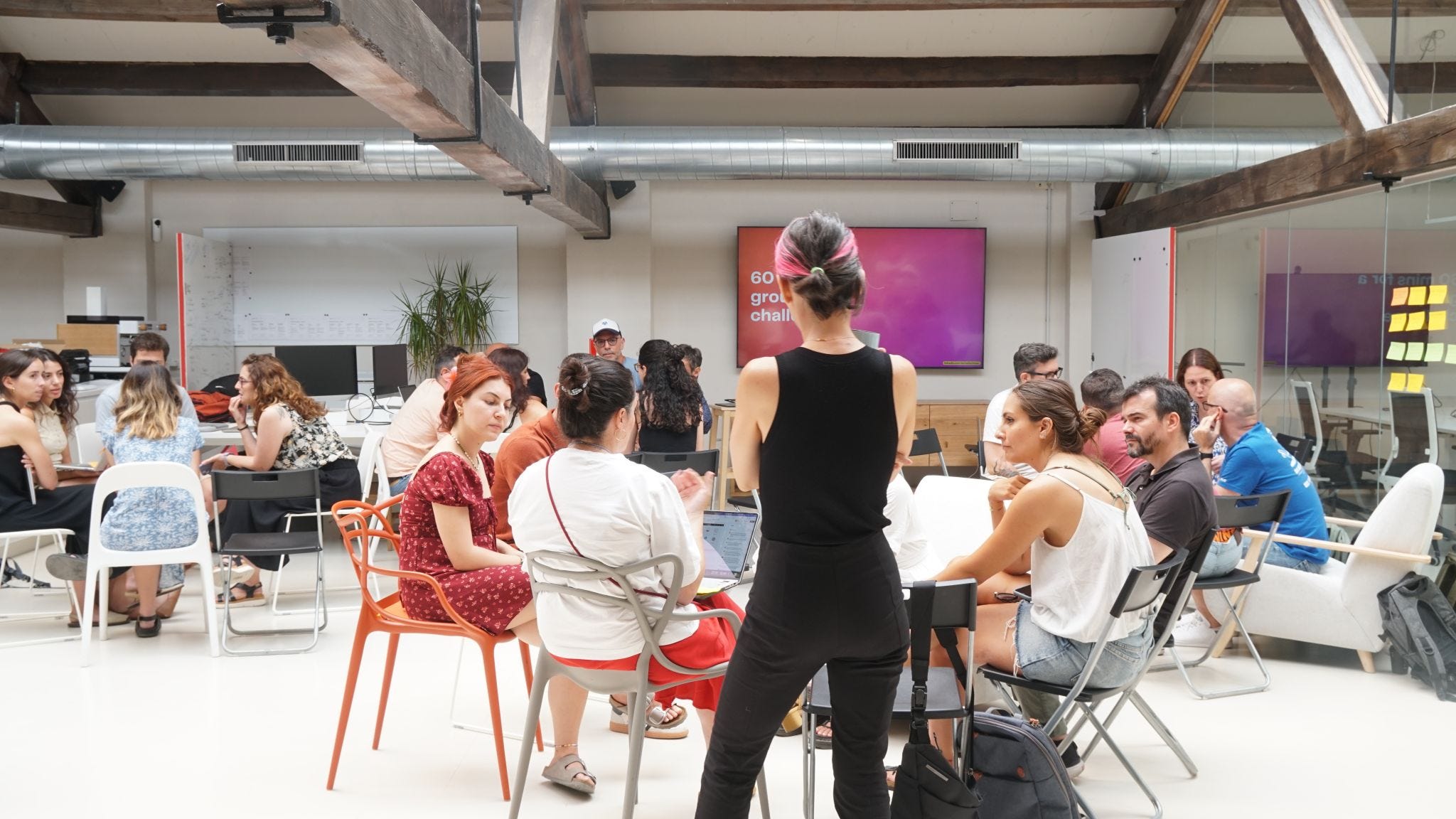
A few weeks ago, I gave a two-day training for the HP team at Nacar. The focus was on giving designers research skills to enable them to run unmoderated testing.
And in the back of my head, I was also thinking about how AI can assist us with anything related to unmoderated testing:
Some early examples include:
🧿 Drafting task instructions
🧿 Sorting large batches of responses
🧿 Generating variations of copy or prompts to explore
Used well, AI can clear the space for us to think and design with more focus. It can accelerate our work.
But AI does not replace the real thinking.
It does not know the hidden context behind your team goals. It does not feel the excitement in the room when a new insight clicks.
The uniquely human part of UX today is building shared purpose. It is asking together the right questions. It is turning a designer, researcher, engineer and product manager from individuals into collaborators who understand not just what they are testing, but why it matters.
When we are at our best as UXers today, we are:
🧿 Framing the right research questions that unlock decisions
🧿 Spotting bias and context that AI might miss
🧿 Engaging stakeholders so insights actually lead to change
🧿 Creating energy and buy-in across the team
These are the moments that AI cannot replicate because they require trust, personal relationships and care, curiosity, and human connection.
What’s the takeaway?
AI will keep evolving. And no one (even in the big tech) knows where exactly things will go. I’m skeptical about its environmental impact and its impact on us when we exclusively rely on it as it can reduce our critical thinking competencies.
But even then, I’m in no denial: AI can be an amazing accelerator for parts of our work. As we speak, I’m collaborating on our UX Burnout Study, leveraging AddMaple’s AI features to connect insights across qualitative and quantitative methods.
Still, the future of UX is not about who prompts AI better.
It is about who can prompt humans.
🧿 Who can ask the questions that create alignment and clarity.
🧿 Who can generate energy in a room full of stakeholders.
🧿 Who can turn insights into action because people feel invested in the outcome.
That is the skill that keeps UX human. That is the skill that will always set you apart in your CV, portfolio, interviews and networking engagements.
So next time you run a test or share insights, remember: the spark comes from humans, not prompts. Keep UX human.
=========
#uxcareer
#careercoaching
👋🏼 I’m Mel, a UX Career Coach based in beautiful Barcelona.
If this post speaks to you, head over to careerwithmel.com
Click Explore the Fit — let’s see what we can build together.